Diamond Rock
A crevasse right through the rock, and a former British warship
Town : Le Diamant
Diamond Rock is the most recognisable landmark in the south of Martinique. It rises 176 metres straight out of the sea, alone, two kilometres off the coast. Underwater it drops to around sixty metres and offers a dozen different routes, from the gentle to the demanding.
The crevasse, and its play of light
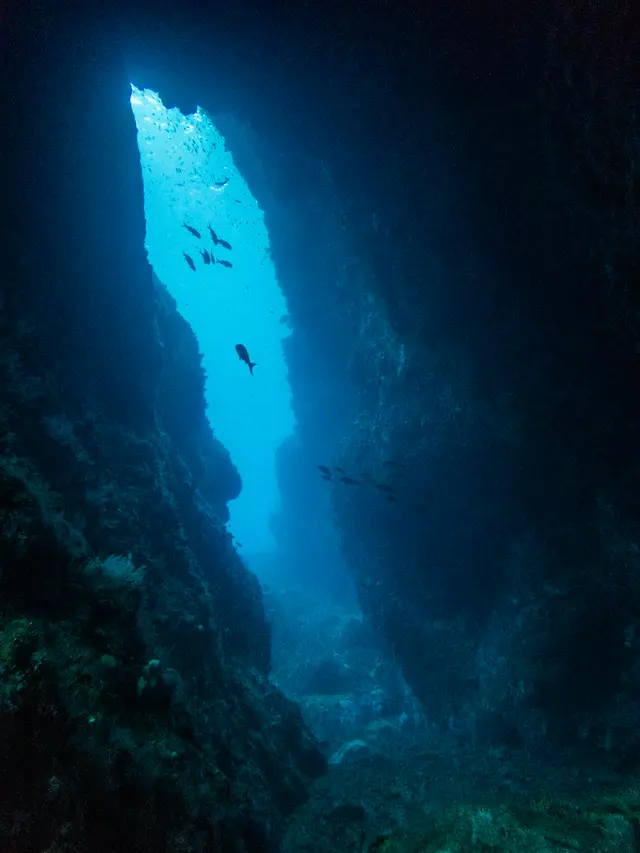
This is what most divers come for. At around fifteen to sixteen metres, a passage cuts straight through the rock: two to three metres wide, five to six metres high, some twenty metres long. You go in one side and come out the other.
Inside, light enters from both ends and carves shapes out of the blue. It is short, and it is the reason so many people remember this particular dive rather than another.
What you will meet
- Sea turtles, often resting on the plateaus.
- Gorgonians along the drop-offs.
- Surgeonfish, parrotfish, groupers and emperors.
- Moray eels in the crevices.
- Lobsters and crabs, tucked into the cracks.
What level you need here
The rock offers a dozen routes between the surface and around sixty metres. There is something for every level, each within the depths their certification allows.
| Your level | Unguided | With an instructor |
|---|---|---|
| Level 1 | — | To 20 m. The crevasse is within reach. |
| Level 2 | To 20 m | To 40 m |
| Level 3 | To 60 m | — |
A Level 3 diver is autonomous, which is the whole point of the certificate. Beyond 40 m they dive with a dive director present, and that deep autonomy applies from the age of 18.
These depths are set by the French certification system and do not depend on the site. Each level is detailed on our courses page.
The real thing to watch
The current. It can run strong at Diamond Rock, and it does not show from the boat. This is exactly the kind of site where knowing the place and reading the conditions makes the difference, and it is the dive director who decides on the day.
When this rock was rated a warship
It is the only rock ever given such a military designation, and the story is thoroughly documented.
On 7 January 1804, in the middle of the Napoleonic Wars, British Rear-Admiral Samuel Hood took the islet from his ship, HMS Centaur. His men hauled five cannon to the summit, three twenty-four pounders and two eighteens. From up there they held the Saint Lucia Channel and harried the French ships coming into Martinique.
The Royal Navy then entered the rock on its books as HMS Diamond Rock, with a lieutenant to command it, Lieutenant Maurice, and one hundred and seven men.
They held out for seventeen months. They slept in the caves, kept goats, guinea fowl and chickens, and hauled their supplies up by rope and pulley.
In 1805 the governor, Villaret de Joyeuse, persuaded Admiral Villeneuve to put an end to it. Captain Cosmao-Kerjulien led the assault. The rock’s cisterns were cracked: with no water and no food left, the garrison surrendered on 2 June 1805.
Some of the English guns are still up there, and can be seen from the town of Le Diamant. So you are diving around a rock that carried a ship’s name for seventeen months, and still keeps its cannon.
A nature reserve since 1994
The rock has been protected by a biotope protection order since 1 March 1994. Landing on it is forbidden: it is a sanctuary for seabirds.
It shelters the brown noddy, the bridled tern and the red-billed tropicbird, and it is the main roosting site for magnificent frigatebirds in Martinique. We dive around it, we do not climb it. On the surface, before kitting up, it is often the birds that hold your attention.