Cap Enragé South
A forest of sea fans, and our try-dive site
Town : Case-Pilote
The southern side of Cap Enragé is a rocky headland backed by a bay no deeper than six metres. It is the busier of the two sides, and by far the more sheltered.
Varied relief in very little water
Canyons, a rocky point entirely covered in sea fans, and a sandy stretch where a genuine forest of sea plumes grows. All of it in very little water.
That variety of relief at so little depth is what makes the site: you see a great deal without ever going deep.
Our try-dive site
This is where we take people diving for the first time. The sheltered six-metre bay lets you take your time, and there is enough to look at that nobody gets bored while the others kit up.
If water makes you anxious, tell us: this is exactly the site for you.
What level you need here
| Your level | What you can do here |
|---|---|
| Try dive | Yes, this is the site we choose |
| Level 1 and above | The whole site |
What you will meet
- Sea fans on the rock, sea plumes on the sand.
- Lobsters and octopus in the canyons.
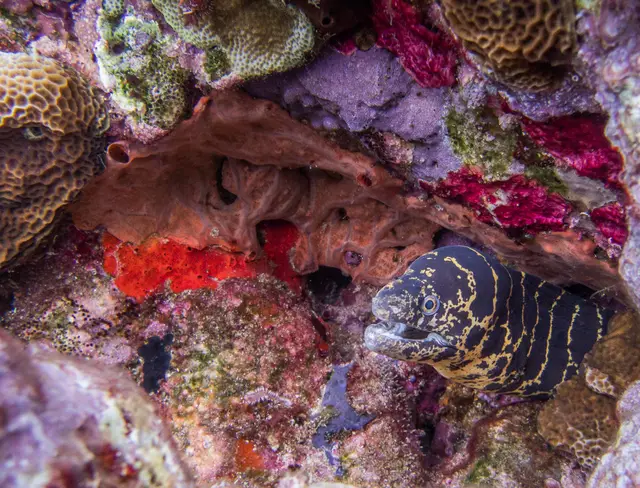
- Moray eels and scorpionfish, for those who look.
- Sponges and a coral garden.
The northern side of the same headland, a few minutes away by boat, offers clearer water and more turtles.
Understanding what you are looking at
Sea fans are everywhere here, and it is worth knowing what they are before you go down. They are not plants: they are animals, colonies of tiny polyps, cousins of the corals but without a hard skeleton. They belong to the soft corals.
Each polyp carries eight tentacles, and each tentacle is lined with minute branches called pinnules. That is what gives sea plumes their feathery look. Those tentacles filter the plankton the current brings them.
Hence the detail that changes everything once you know it: a sea fan does not grow towards the sun like a plant, but at right angles to the current, to offer it as much surface as possible. On Cap Enragé South, look at how they all face the same way: they are showing you where the water comes from.
Fans and plumes, two shapes
- Sea fans, on the rocky point: wide latticed sails standing into the current.
- Sea plumes, on the sand: softer and bushier, they sway rather than resist.
Both grow slowly, a few centimetres a year. A large sea fan is several decades old. That is also why we never touch them.
Where we leave from
As for the northern side, trips leave from the harbour at Case-Pilote, and we bring all the equipment.